


On September 4, 1622, twenty-eight ships cast off from the port of Havana, bound for Spain. They left late. With the hurricane season already underway.
It was not an improvised fleet. It was a studied system, with decades of experience. At the front was the captain’s ship. Closing from behind sailed the admiral’s ship, an impressive Spanish armed galleon, which sailed last so that no one could attack the fleet from behind. In the middle were the cargo ships.
Each ship had a job. None did the other’s.
Two days later, off the Florida Keys, a hurricane fell upon them.
Twenty ships held out and managed to return to Havana.
Eight went to the bottom of the Caribbean.

Among the shipwrecks was the galleon “Nuestra Señora de Atocha”. The fleet’s flagship. The galleon that protected all the others and which, at the same time, carried a huge portion of the voyage’s value in its hold: 24 tons of silver, 180,000 pesos in coins, 582 copper ingots, 125 gold bars, 350 chests of indigo, and quite a few other things.
And there were also 265 souls on board. Five survived. Three sailors and two slaves, clinging to the stump of the mizzenmast, which was the only part of the galleon that did not sink.
The fleet system, by the way, worked. Twenty out of twenty-eight ships returned to port. That was what it had been invented for.
What went wrong was putting the protection and the bulk of the treasure on the same ship, the largest one. Too much concentrated risk.
And from there I move on to your ecommerce stuff.
Your business is also like a fleet
Almost all the conversations I have about sales channels start with the wrong question. Whether two channels or five. Whether a standalone store is enough. Whether you need to be everywhere. Whether you have tried this new channel…
That question leads nowhere.
The one that does lead somewhere is this: what work you have assigned to each channel.
A fleet is made of distinct ships, with distinct missions, sailing together. It occurred to no one to build a fleet with twenty-eight copies of the same ship.
And yet, most stores I see do not have a fleet. They have one huge galleon (their only sales channel) and a rowboat tied up, just in case.
And that is a mistake.
The four jobs a channel can do
These are the roles you can assign to each channel where you decide to sell:
Margin. Usually your own store. It is where you keep almost everything the customer pays, where you have their email, and where you decide what the experience is like. And where you build loyalty. It is also where every visit costs money to acquire. That is the deal.
Volume. Pure turnover. Moving stock, hitting manufacturing minimums you couldn’t reach on your own, clearing out what was left over from last season. The margin per order is lower, but in exchange, you don’t pay as much to generate demand.
Discovery. People who didn’t know you and would never have searched for you. Here, the metric that matters isn’t provided by the channel itself. It’s provided by your website, three weeks later, when someone types your brand name into a search engine and ends up buying from you directly.
Market testing.Put a hundred and twenty references in Italy and see what happens. Before translating the website, hire customer service in Italian and sign a lease for a warehouse there.
Four jobs. One channel can do two, but rarely three.
The mistake that costs dearly
Almost no one breaks because of having too many open channels.
They break because of asking the same result from all of them.
If you demand from a volume channel the same margin your own store gives you, you’re going to shut it down in three months, convinced it didn’t work.
And it did work. You had just given it the wrong job.
And now about the focus, which I know you’ve been thinking about for the last three paragraphs.
I solve it this way. One main channel, the one that pays the salaries.
One or two subordinates, each with their job written in a single line, literally written. And no more until the ones you already have work without you being on top of them every single day.
The blur doesn’t appear when you open the fourth channel. It appears when you open it without having decided which one is in charge.
ℹ️ By the way, this whole looking at the actual margin instead of the ROAS to know what is really working for you I’m going to set it up live, with AI, this Thursday. I’ll tell you about it at the very bottom.
Why haven’t you opened that channel yet?
I’m asking you seriously. If you’ve made it this far thinking “I lack volume” or “I lack discovery”, something has held you back until today.
And in my experience it is always the same three things:
▶︎ Complexity. Opening a new channel is not just filling out a registration form. It is VAT in four countries, product certifications, environmental EPR, logistics you do not have set up, and payment methods that are different in every place. And all of that has to be carried out by the same person who is already doing nine other things.
▶︎ Cost. It is never just an isolated expense. It is software, plus logistics, plus people, plus commissions. All together, and almost all before selling the first order. There are industry associations that estimate a complete omnichannel operation at up to 100,000 euros per year.
▶︎ Connection. This is the one that is least talked about and the one that stings the most. You sell within a system you do not quite understand, something breaks, and you do not know who to write to. And when you do write, a form replies to you.
Complexity, cost, and connection. The three things that keep a bunch of small businesses selling only in their digital neighborhood.
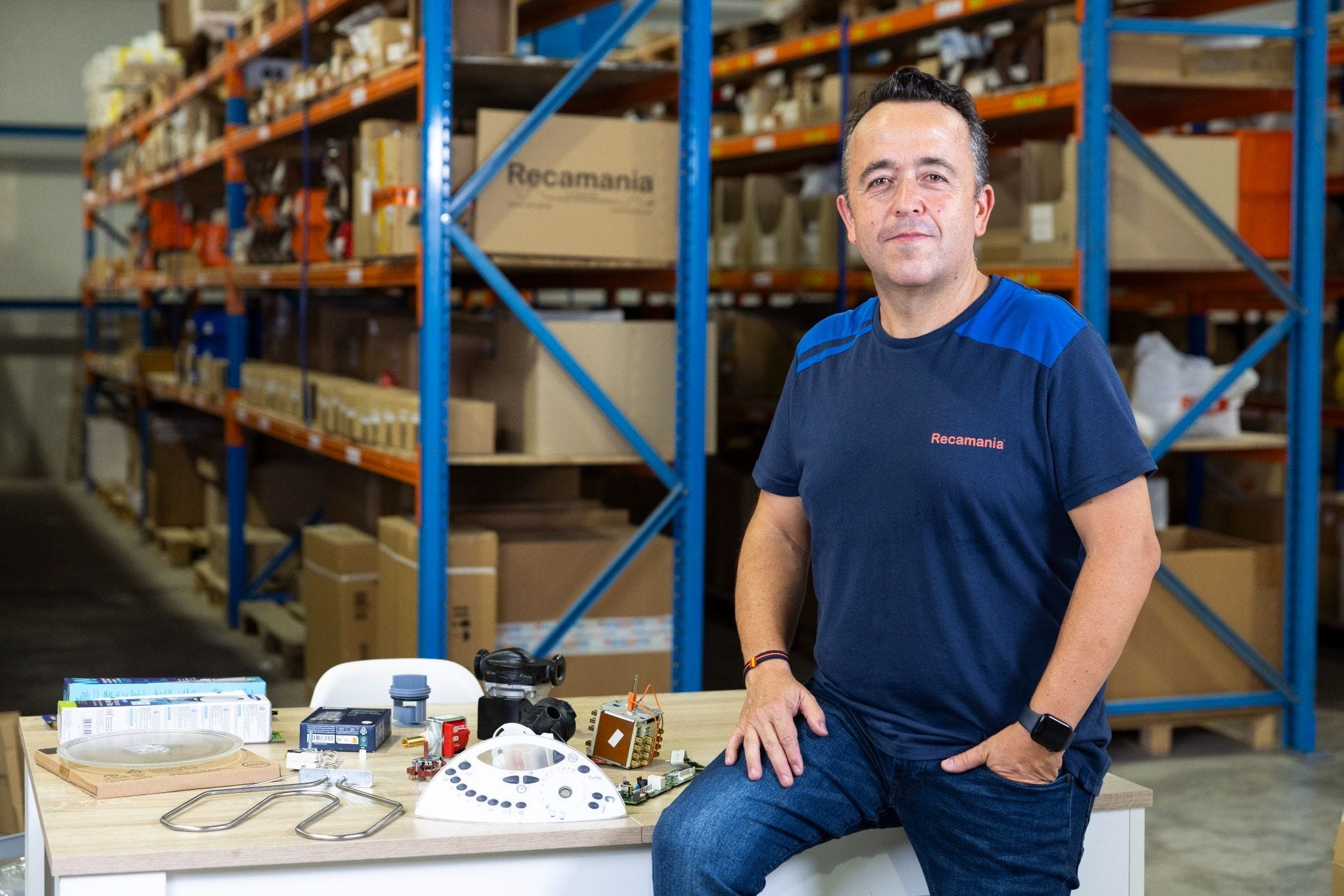
The success story that best explains it: Recamania
Recamania has spent four decades in Albacete selling appliance spare parts. Forty years helping people repair instead of throwing things away.
In 2020, they closed their physical store to focus on online sales. And there they ran into everything mentioned above all at once: 5,000 references they didn’t know how to manage on their own website, platforms where traction took months, no guarantee that anyone would see them, and international expansion that added different regulations, logistics, and requirements in every country.
They signed up for Temu in May 2025. The process only took them two weeks, with a support team assisting Pedro Juan Castillo, their director, with opening the store, uploading products, day-to-day operations, and managing returns.
300 orders in the three days after publishing. 4,000 in four months.
Today, Temu accounts for 20% of their online revenue, and the cumulative orders in their marketplace store have already exceeded 23,000.
Oh, and they have had to hire people to manage this new line of business.
The next thing they want to do is upload their full catalog to France, where they have already started selling, and expand into Germany and Italy via Temu.
What I would do with my month of August
August has one good thing. The noise dies down, the volume of orders drops, and you finally have time to think about something other than putting out fires.
It is the only month of the year in which you can set up a new channel without blowing up the operation.
This is how I would do it, week by week:
Week 1. Choose and assign the work.
A new channel. Only one. And you write in one line why you are opening it: volume, discovery, or market test. Then you decide which part of your catalog goes there and which doesn’t. Almost always what goes first is the reference with good turnover and defendable margin, not your flagship product. To test.
Week 2. Minimum viable catalog.
Twenty or thirty references. Not five thousand. Descriptions rewritten for that specific channel (here AI can help you a lot), images that are readable on mobile, and prices calculated backwards, with the REAL commission and shipping costs already factored in before publishing anything. This is the step most people skip and the one that later makes them say the channel didn’t yield a profit margin.
Week 3. Logistics and returns.
The key question: who is going to pack this in November, when a hundred orders come in a day and you also have your own campaign on top of it? If the answer is “we’ll see,” the channel is dead before it’s even born.
Week 4. Onboarding, testing, and first orders.
Launching with a light load is a gift. You can make mistakes with the label, the packaging, and the lead time without it costing you a few bad reviews in the middle of the Christmas campaign.
And one more thing, the one almost no one does.
Write down the cutoff criterion today. A specific number and a specific date. For example: if by January this channel hasn’t reached X orders per month with Y margin, I’ll close it without any drama.
Writing it down now, in cold blood, is what will allow you to make a good decision in January, when you’ve already grown fond of your creation.
Come on, go ahead and open a new channel.
But hurry up, the hurricanes are coming.
The 1622 fleet left late. September 4th, with hurricane season already upon them, and yet they set sail.
You have the entire month of August ahead of you and no hurricanes on the horizon.
Take advantage of it to see what ships you have, what each one does, and which one is missing from your ecommerce fleet.
See you in September.
Best regards,
Pablo Renaud